
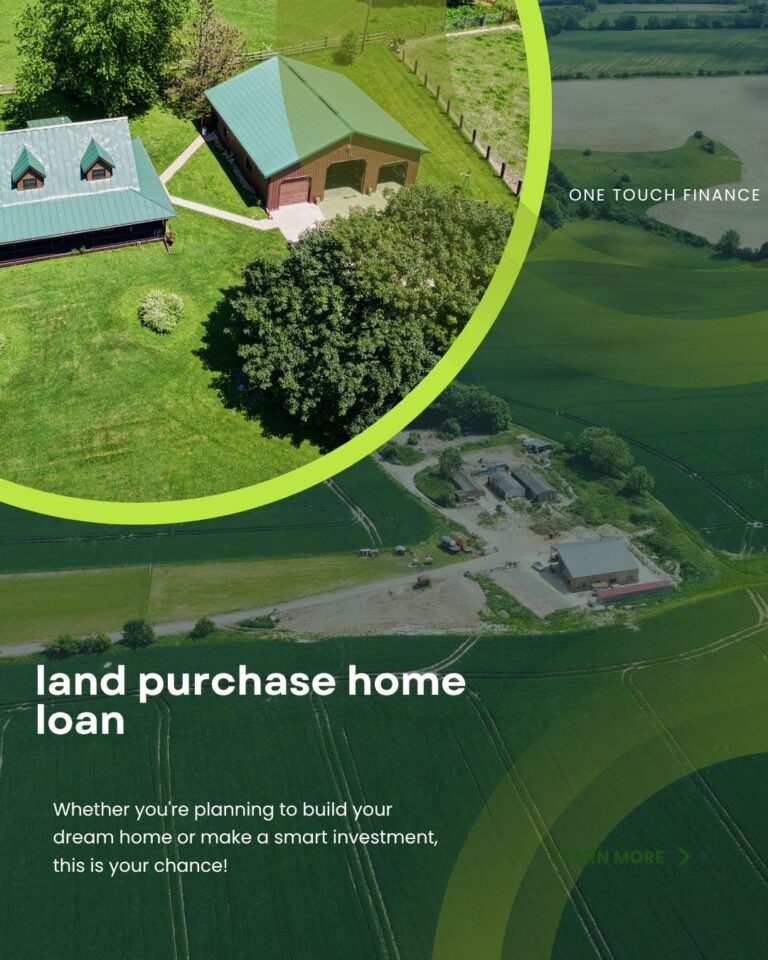
Your land. Your rules. Your home
You’ve always dreamed of building a home that looks and feels exactly the way you want it.The first step? Owning the land. I’m here to help you do that. Rates from 8.10% p.a. | Up to 80% funding | Tenure up to 15 years |
What is a plot loan?
Think about it — most home loans only help you buy a ready-made house. But what if you want to build your own? A plot loan gives you the money to buy the land first, so you can design and build the home you’ve always pictured. With PrimeGround Finance, you get the funding you need at a rate you can afford, and I’ll walk you through every step.
One thing to keep in mind: your plot must be in an approved residential layout or a registered development. You’ll also need to start construction within 36 months of getting your loan — so plan! |
How much will you pay every month?
I know the first thing you want to know is: “What does this cost me each month?” Fair question. Here’s a real example so you can see exactly what to expect before you even apply.
What you put in | Example value |
Loan amount | ₹ 30,00,000 (thirty lakhs) |
How long will you repay | 15 years |
Interest rate (per year) | 8.10% — floating / repo-linked |
Your monthly EMI | ₹ 28,714 |
What you borrowed | ₹ 30,00,000 |
Total interest over 15 years | ₹ 21,68,520 |
The total you pay back | ₹ 51,68,520 |
This is just an example. Your actual EMI will depend on your loan amount, the rate you’re offered, and how long you choose to repay. Talk to one of our team members, and I’ll get you a number that’s built around your life.
What rate will you get?
Your rate is linked to the RBI’s Policy Repo Rate. That means when the Repo Rate goes down, your rate can go down too. Right now, the Repo Rate sits at 5.75%.
Current Repo Rate: 5.75% (updated by RBI from time to time)
Who you are | Loan range | Your rate (% per year) |
Salaried person | Any amount | Repo Rate + 2.35% = 8.10% onwards |
Self-employed professional | Any amount | Repo Rate + 2.50% = 8.25% onwards |
Self-employed non-professional | Any amount | Repo Rate + 3.00% = 8.75% onwards |
NRI borrower | Any amount | Repo Rate + 3.25% = 9.00% onwards |
These rates are a starting point. Your final rate depends on your credit profile and the result of your loan assessment. The cleaner your credit history, the better your chances of getting a lower rate.
Can you get this loan?
Let me keep this simple. If you earn a regular income, you’re between 21 and 65 years old at the time your loan ends, and you’re an Indian resident (or NRI), you’re likely eligible. Here’s a quick breakdown.
Basic requirements
What we check | What you need |
Your age | 21 years minimum — max 65 at the time the loan ends |
Who can apply | Salaried workers, self-employed professionals, and self-employed non-professionals |
Where you live | Resident Indians and NRIs with eligible income |
Loan length | As short as 2 years, as long as 15 years |
Credit score | 700+ on CIBIL (or a similar bureau) is ideal |
Co-applicant | You can add one — all co-owners must also be co-applicants |
How much of the plot cost will I fund?
You don’t have to pay the full price upfront. Here’s how much I can lend you based on your loan amount.
Your loan size | Max funding (of assessed property value) |
Up to ₹ 30 lakhs | 80% — you pay just 20% yourself |
₹ 30.01 lakhs to ₹ 75 lakhs | 80% — same deal |
Above ₹ 75 lakhs | 75% — you cover 25% |
Plots outside city limits | Up to 70% — a little more from your side |
These limits apply to direct allotment cases. The final funding amount depends on a property valuation and your repayment capacity as assessed by our credit team.
Are you self-employed? Here’s where you fit
Self-employed professional (SEP) | Self-employed non-professional (SENP) |
Doctors, dentists, surgeons | Traders and retail shop owners |
Chartered accountants, cost accountants | Contractors and sub-contractors |
Architects and interior designers | Commission agents and brokers |
Engineers and consultants | Manufacturers and small industry owners |
Company secretaries, lawyers | Unlicensed trades and service providers |
How much loan can you get? (real example)
Use this as a rough guide. If your monthly income is ₹ 50,000 and you already pay ₹ 5,000 in other EMIs each month, here’s what you could be eligible for.
What I look at | Your numbers |
Monthly income (gross) | ₹ 50,000 |
Other EMIs you already pay | ₹ 5,000 per month |
Rate used for this estimate | 8.10% per year |
Repayment period considered | 15 years |
Your estimated loan eligibility | ₹ 28,50,000 (approximately) |
Your estimated monthly EMI | Approx. ₹ 27,350. |
Want to borrow more? Add an earning family member as a co-applicant. Their income gets added to yours, and your total eligibility goes up. It’s one of the easiest ways to unlock a bigger loan. |
What documents do you need?
I’ll be upfront with you — there is some paperwork involved. But it’s mostly straightforward stuff you probably already have at home. Here’s everything you’ll need to submit along with your completed application form.
KYC and identity documents
Sr. | Document | Identity proof | Address proof |
1 | PAN card (mandatory for everyone) | Required | — |
2 | Aadhaar / UIDAI letter | Yes | Yes |
3 | Valid passport (not expired) | Yes | Yes |
4 | Valid driving licence (not expired) | Yes | Yes |
5 | Voter ID card | Yes | Yes |
6 | NREGA job card (signed by State Govt. officer) | Yes | Yes |
7 | National Population Register letter | Yes | Yes |
If your name has changed since any of these documents were issued, just bring a marriage certificate or Gazette Notification along with them. That covers you.
Income documents — if you’re salaried
- Your last 3 salary slips from your current employer
- Last two years’ Form 16 or Income Tax Return documents.
- Bank statements from your salary account — last 6 months
- Offer letter or appointment letter if you’ve been at your job less than a year
Income documents — if you’re self-employed
- Last three years’ Income Tax Return (ITR) filings, including computation of income.
• Audited Profit & Loss statements and Balance Sheets for the preceding three financial years.
• Last 12 months’ bank statements for both business and personal accounts. - Proof of business continuity and registration (GST certificate, shop licence, partnership deed, MoA/AoA, etc.).
Property documents
- Original title deed chain showing clear ownership
- Sale agreement or allotment letter from the developer or authority
- Latest property tax receipts (where applicable)
- Approved layout or survey plan from the local town planning authority
- Encumbrance certificate for at least 15 years (or from the date of first registration)
- Non-agricultural land use certificate (where required)
- NOC from housing society or RWA (if the plot is in a gated community)
What does it cost to get this loan?
I want you to know exactly what you’ll pay — no surprises. Here’s a clear breakdown of every fee involved. All amounts are before GST and other government charges unless I’ve said otherwise.
Good news: if you’re a senior citizen (60+), you get a 10% discount on all service charges.
Processing fee (paid once, non-refundable)
Who you are | Processing fee |
Salaried/self-employed professional | Up to 0.50% of your loan or ₹ 5,000 — whichever is higher, plus taxes |
Self-employed non-professional | Up to 1.50% of your loan or ₹ 6,000 — whichever is higher, plus taxes |
NRI borrower | Up to 1.50% of your loan or ₹ 5,000 — whichever is higher, plus taxes |
Reach / Value Plus scheme | Up to 2.00% of your loan plus taxes |
If you want to switch your rate or pay off early
What you’re doing | What it costs |
Switching from a floating to a fixed rate | Up to ₹ 3,500 per switch |
Switching from fixed to floating rate | Up to 1.50% of your outstanding principal |
Paying off a floating-rate loan early | Nothing — it’s free |
Paying off a fixed-rate loan (your own money) | Nothing — it’s free |
Paying off a fixed-rate loan (borrowed money) | 2% of the amount you pay off + taxes |
Re-appraisal after 6 months of sanction | Up to ₹ 3,500 (salaried/SEP) | Up to ₹ 5,500 (SENP/NRI) |
Other charges you should know about
What it’s for | How much |
Duplicate loan statement or document list | Up to ₹ 600 per request |
A photocopy of your title or security documents | Up to ₹ 600 per document |
Changing your repayment method (NACH/ECS) | Up to ₹ 600 per change |
Bounced or returned payment | ₹ 500 each time |
CERSAI registration charges | Actual cost — up to ₹ 120 |
Keeping your documents after loan closure | ₹ 1,200 per month after 2 months from closure |
Administrative charges | Up to ₹ 6,000 + taxes |
Stamp duty, MOD, registration | Actual cost as per your State’s rules |
Mortgage guarantee fee | Actual cost charged by the third party |
If you miss a condition in your loan agreement (like providing security documents on time), you may be charged up to 2% per year on your outstanding balance — capped at ₹ 50,000 for critical security issues and ₹ 25,000 for others.
A few things I want you to remember• All fees are non-refundable once you’ve paid them. • Senior citizens (60+) get 10% off all service charges. • Availing a business loan up to ₹5 lakh (MSE)? Processing charges are waived upon submission of your URC before disbursement. • MSE loans up to ₹ 50 lakh? No early closure charges at all. • If you miss an EMI, interest is charged at your contracted rate for each day it’s late. It gets added to your next EMI. • When you pay back early, I may ask you to show where the money came from. |
Questions you probably have
Can this loan help me purchase agricultural land?
No — and I want to be clear about that upfront. This loan is only for residential plots in approved layouts or registered developments. Agricultural land does not qualify under this product.
What’s the longest I can take to repay?
You can repay over a maximum of 15 years. The only condition is that you must be 65 or younger when the loan ends. Your income level and credit profile will also help determine the best tenure for you.
Should you add a co-applicant?
Yes — I’d strongly encourage it if you want to borrow more. When you add an earning family member as a co-applicant, their income gets combined with yours. That means your eligibility goes up. A quick note: all co-owners must be co-applicants, but co-applicants don’t have to be co-owners. Most people add a spouse, parent, or adult child.
Will you pay a penalty for paying off early?
Floating rate loan? Zero foreclosure fees, no matter where the repayment money comes from. Fixed-rate loan repaid from personal savings? Also free. Charges apply only when a fixed-rate loan is closed using borrowed funds—2% of the prepaid amount plus taxes.
How does the money actually get to the seller?
Once your loan is sanctioned and your documents are all in order, the disbursement is paid directly to the seller or developer. This typically happens right after the sale deed is signed and registered. If your payment plan is split into stages, I can arrange disbursement in parts to match that schedule.
How do I know how much loan I’ll get?
I look at your total picture — your net monthly income, any existing loan EMIs, your chosen tenure, your credit score, how stable your job or business is, and the value of the plot you want to buy. Our credit team looks at all of this together to arrive at a number that works for you.
Contact Us Today
Ready to start your journey toward building your dream home? Our experienced loan officers specialize in land purchase and construction financing. Contact us today for a personalized consultation and competitive rate quote.